 Students that graduate from the Master of Science in Nuclear Medicine and Molecular Imaging Sciences program are well prepared for a variety of different career paths.
Graduates with certifications are equipped to start working immediately as a nuclear medicine technologist, with further career options to work as multi-modality imaging specialist, nuclear regulatory commission license eligible radiation safety officer, or as an independent researcher.
Career and Salary Outlook for Nuclear Medicine
The U.S. Bureau of Labor Statistics projects the field to grow five percent faster than the average occupation through 2029.
Where The Jobs Are
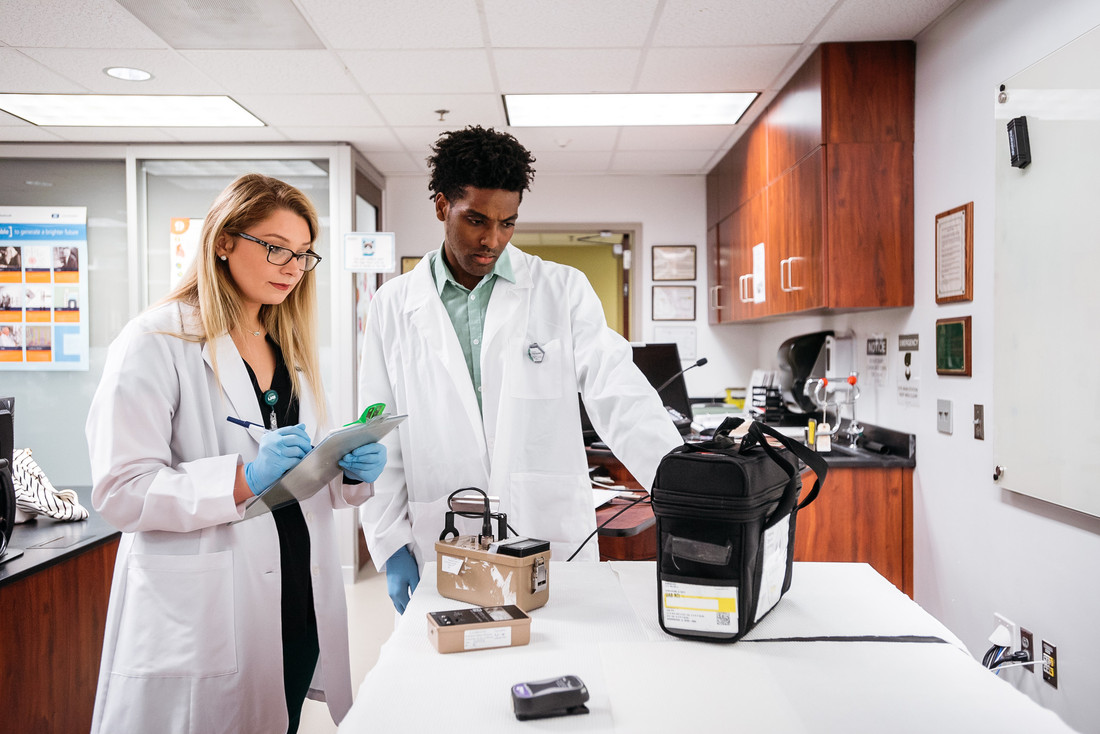
The majority of graduates work in the hospital setting within a Nuclear Medicine Department. Others work in outpatient facilities and physician offices. Some students become travel technologists and work with a company to provide care to areas where access to care for patients is low. Some graduates choose to work in industry, helping to develop and train individuals on the latest technology in Nuclear Medicine and Molecular Imaging. Still, others go into research and help develop new Nuclear Medicine radiopharmaceuticals to help diagnose and treat diseases in patients. Our students are also eligible to become the Radiation Safety Officer for a hospital and help enforce radiation safety practices for employees.
1,000 Hours of Experience
One other unique aspect that the Master of Science in Nuclear Medicine and Molecular Imaging Sciences offers is that graduates receive about 1,000 hours of hands-on, clinical experience while in the program. These hours can be difficult to obtain outside of a program like this, and these clinical hours are valuable especially for our graduates that choose to further education in medicine. The Master of Science in Nuclear Medicine and Molecular Imaging Sciences is the gateway to success for many students at UAB.
Many students use this valuable clinical experience as a springboard for furthering their graduate education in medicine and biomedical sciences. Many of our graduates with their specialized knowledge and skills have gone on to medical, dental, and PA school or have pursued PhD studies or post-doctoral position.
Society of Nuclear Medicine and Molecular Imaging
The Society of Nuclear Medicine and Molecular Imaging has "What Patients Need to Know About Nuclear Medicine and Molecular Imaging," a more detailed look at what technologies a Nuclear Medical Technologist might work with.