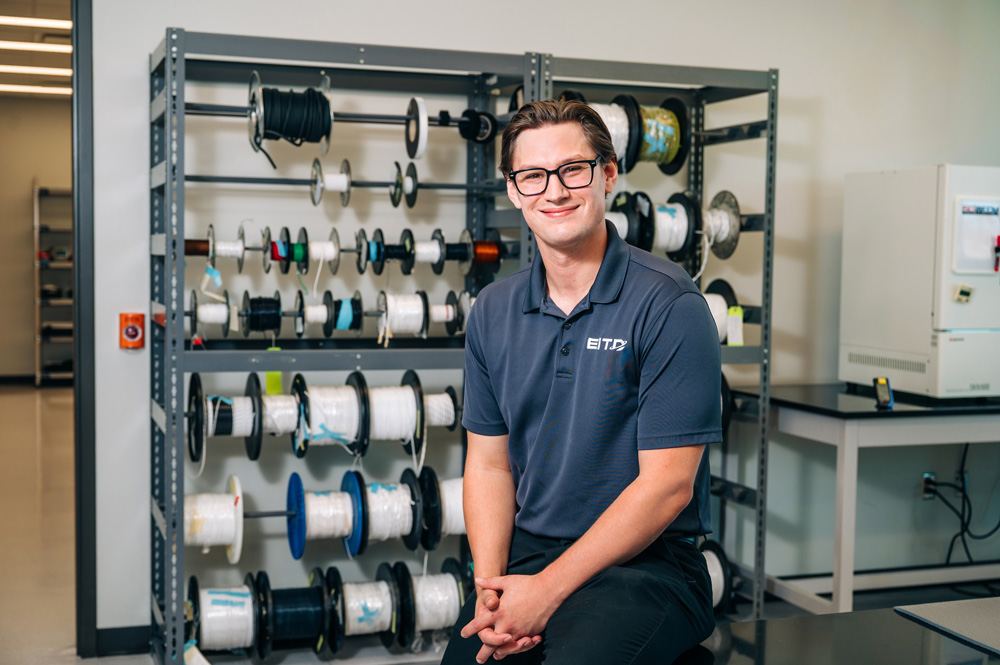
 Nicholas Collins in the EITD labs in Gorrie HallOne of the perks of working in the School of Engineering’s impressive new building, Gorrie Hall, is the view. When the time is right, Nicholas Collins can look up from his lab bench on the fourth floor and see the moon hanging over the diamond at Jerry Young Memorial Field next door.
If everything goes according to plan, the space freezer prototype that Collins is helping to build today will be up there, being filled with soil samples collected by Artemis astronauts, in 2030.
At that point, Collins will be well on his way to a personal moonshot — earning his bachelor’s degree in electrical engineering while working as an electronics specialist with UAB’s Engineering and Innovative Technology Development group, or EITD. With that combination of education and experience, he will be a pretty hot shot on the job market.
“Nick is getting his certifications in all the soldering and harnessing work that he does, and getting his degree is going to help us as well,” said Chad Duke, director of the EITD. The team has a long history of landing major NASA contracts. In December 2025, they received a $37 million award to design, develop, manufacture, test and deploy the Lunar Freezer System that is a key part of NASA’s Artemis moon missions. (Read more about the Lunar Freezer System in this related story.)
“Electrical engineers with the experience we need are hard to come by, and with our Lunar Freezer System contract added to our existing NASA and other work, we have had to staff up,” Duke said. “There are aerospace and technology companies across the state that are looking for people with these skill sets as well. With his work experience and his degree, Nick will have a lot of opportunities.”
Collins is in no hurry to leave; in fact, he just got engaged and signed a contract on a house in Birmingham. And the work is fascinating, he says. When he first interviewed for the EITD job in 2023, Collins learned that his responsibilities would include supporting the team’s cryogenic freezers, which are an important part of the scientific work happening on the International Space Station. “The opportunity to contribute to projects that directly support scientific advancement and space exploration immediately stood out to me, and I knew it was something I wanted to be a part of,” Collins said.
UAB’s Educational Assistance benefit was another draw of working for the university, Collins adds, because getting his four-year degree was always a goal. When he started taking classes toward his electrical engineering degree last year, he had a source of inspiration nearby: his supervisor, Andy LaGrone. “Andy worked at EITD while pursuing his engineering degree,” Collins said. “When I encounter a difficult concept in class, he is often able to connect it to a practical engineering application, making the material easier to understand.”
Collins tries to take one in-person class each semester — “a more conceptual class like calculus,” he said — and one or two online courses, like the Computer Aided Graphics and Design class he is taking in fall 2026. “Through experience, I have found that this is the ideal balance for me,” he said. “It allows me to continue making steady progress toward my degree while ensuring I fully understand and retain the material. It also allows me to effectively balance my educational responsibilities with my work at EITD.”
Collins and his fellow technicians Bryan Neely and Kenny Hicks have been heavily involved in assembling EITD’s prototype, known as the Technological Demonstration Unit, for the new Lunar Freezer System. They are building circuit boards using advanced soldering techniques, fabricating wire harnesses and assisting with hardware integration efforts “that will support the next generation of cryogenic storage technology for future exploration missions,” Collins explained.
“One of the things I enjoy most about my role is the variety of responsibilities,” he added. On a typical day, Collins may be managing and tracking calibrated equipment, “including coordinating with calibration vendors, many of whom are small businesses that we actively support,” he said. He also maintains, inspects and repairs the equipment for EITD’s NASA Cold Stowage Services Contract — everything from replacing piezoelectric fans and troubleshooting hardware issues to “completing preventive maintenance activities that help ensure reliable operation during future missions,” he said.
Working and going to school make for some long days. “There is a lot going on,” Collins said. “But I’m happy with the place where I am now and where I am headed.”
The combination of work and education “creates a stronger learning experience,” Collins said. “The classroom teaches you why something works, while the workplace shows you how and where those principles are applied. Together, they reinforce knowledge in a way that leads to a deeper and longer-lasting understanding.”