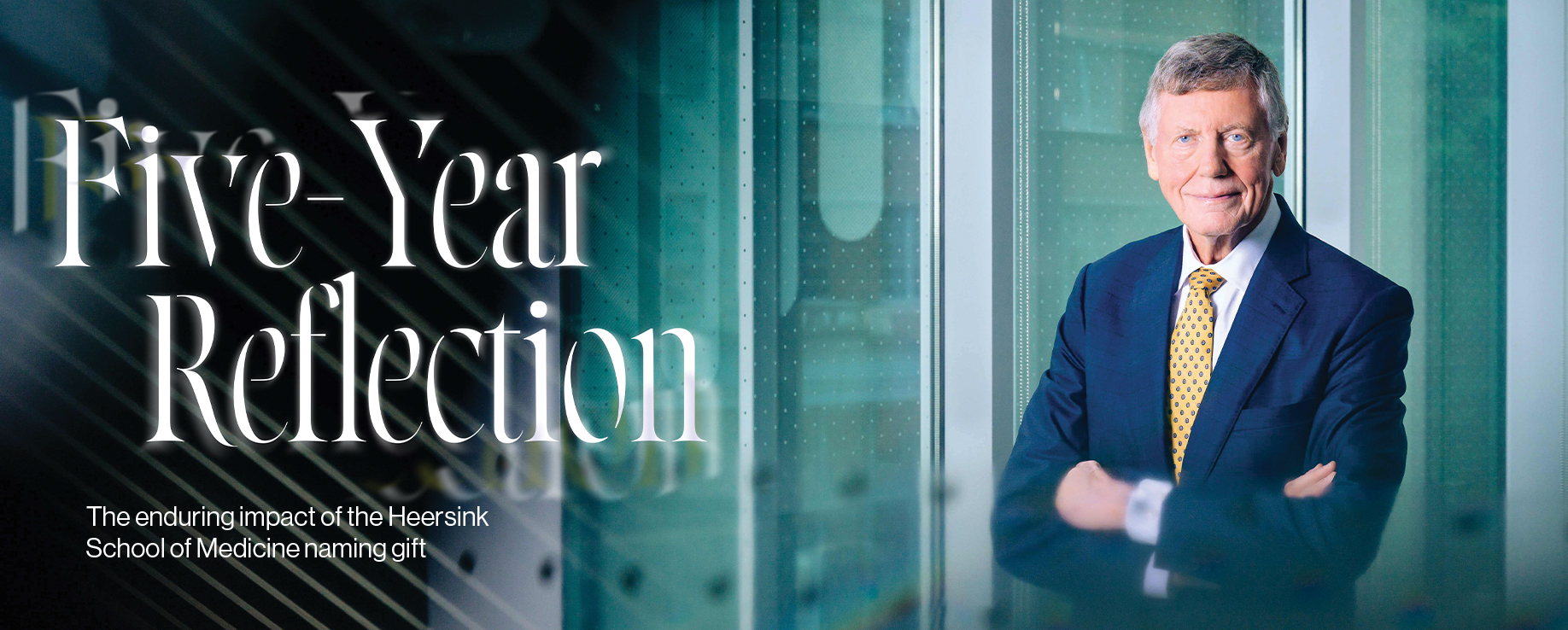
The enduring impact of the Heersink School of Medicine naming gift
Shakespeare famously asked, “What’s in a name?” For the UAB Marnix E. Heersink School of Medicine, the answer lies in the enduring impact of the transformational $100 million gift from ophthalmologist, entrepreneur, innovator, and philanthropist Marnix Heersink, M.D., and his wife, Mary Parks Heersink, that not only named the school but also launched a new era of opportunity, innovation, and engagement.
Five years later, that historic commitment, still the largest philanthropic gift in UAB's history, has evolved into a powerful catalyst for attracting world-class talent, advancing biomedical innovation, expanding global health initiatives, creating engaging learning environments, and fortifying the school's position as a leader in academic medicine.
Approx. 170
learners across all Biomedical Innovation Institute Academic programs in 2025
455
students, faculty, and staff participating in global health activities in 2025
92
partner institutions across 49 countries
The Heersink gift was never intended simply to put a name on a building—it was designed to accelerate an existing upward trajectory by investing in people, innovation, and partnerships. In addition to naming the school, the gift established the Marnix E. Heersink Institute for Biomedical Innovation, the Mary Heersink Institute for Global Health, and the Marnix E. Heersink Conference Center, and provided resources to recruit and retain exceptional faculty.
Today, the impact can be measured in endowed chairs and professorships, innovative degree programs, new global partnerships, research discoveries, entrepreneurial ventures, and revitalized learning spaces. Yet perhaps the most meaningful measure of the gift's success lies in the people whose lives it has touched.
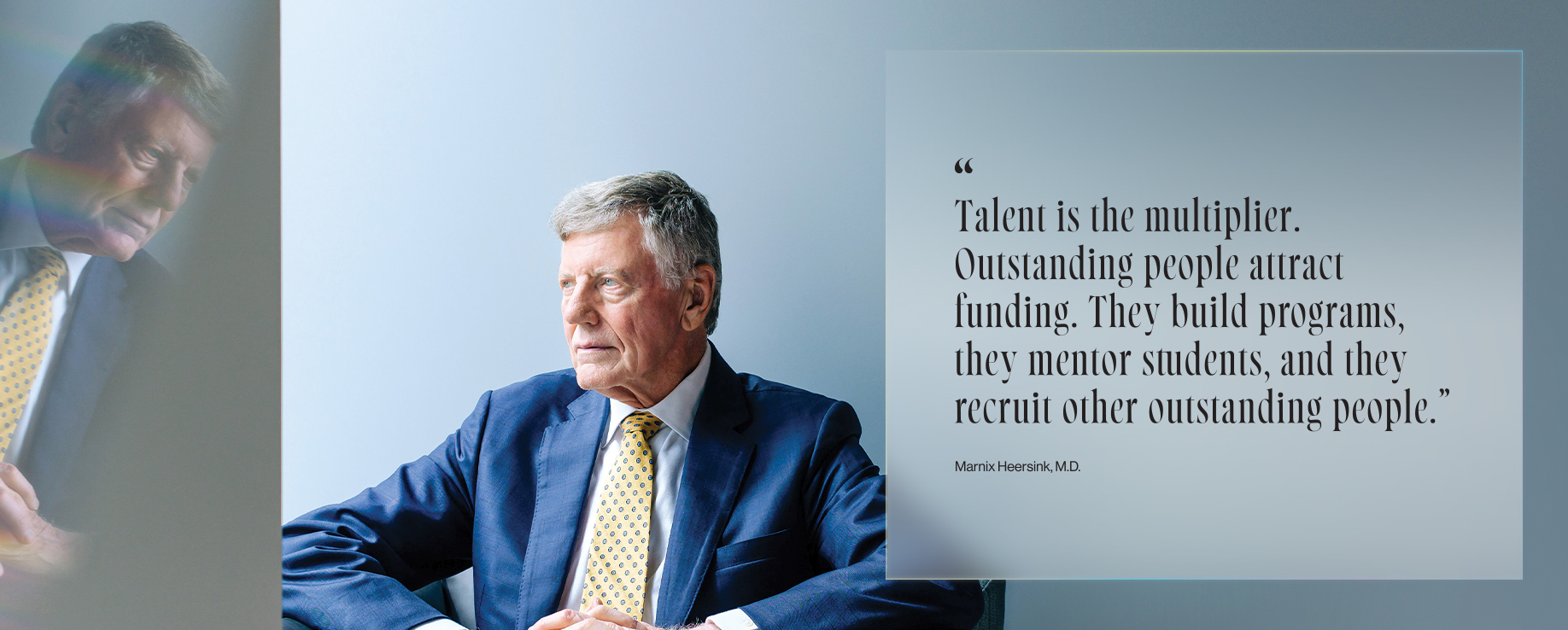
"Talent is the multiplier," Heersink said. "Outstanding people attract funding. They build programs, they mentor students, and they recruit other outstanding people.'
A life shaped by opportunity and service
Born in the Netherlands and raised in Canada, Marnix Heersink learned the value of persistence and commitment early. As a child, he delivered newspapers and later combined academic pursuits with entrepreneurial ventures. A standout basketball player at the University of Western Ontario, he was invited to compete for Team Canada in the 1972 Olympics before ultimately choosing medicine as his life's work. He earned both his bachelor's degree and medical degree from the University of Western Ontario, completed an internship at Royal Victoria Hospital in Montreal, and then pursued ophthalmology residency and fellowship training at Wills Eye Hospital in Philadelphia, where he met his wife, Mary, the daughter of renowned pediatric ophthalmologist Marshall Parks, M.D.
In 1978, the couple arrived in Dothan, Alabama, with little more than "a used car, some clothes, and a lot of love and hope;' as Heersink recalled. From those humble beginnings, he co-founded Eye Center South, which grew into a regional eye care practice serving Alabama and Florida. He later developed Health Center South, a medical complex designed to expand access to healthcare in the Wiregrass region. Along the way, Heersink built a reputation not only as a physician and entrepreneur but also as a champion of innovation, education, and philanthropy.
The Heersinks' dedication to service has been passed on to their six children, each of whom works in a health profession. They include three Heersink School of Medicine alumni—ophthalmologists Mila Heersink, M.D., and Marius Heersink, M.D., and family medicine physician Christiaan Heersink, M.D.—as well as ophthalmologist Sebastian Heersink, M.D., internist Damion Heersink, M.D., and UAB School of Dentistry graduate Bayne Heersink, DMD.
The three “Es” in action
When the naming gift was announced in 2021, Heersink spoke frequently about a framework that had shaped his family's decision to invest in UAB. He called it the "Three Es": Excellence, Expansive, and Encompassing. He believed those qualities distinguished UAB and positioned the institution for even greater impact.
Today, he sees those values alive throughout the school's growth. "We see excellence across many different areas,” Heersink said. "Being expansive is important to our family because it means crossing boundaries. And the one that I really like is encompassing. Science and STEM are critical, but so are the humanities. Silos are great, but they're meant to hold grain, not people.”
Those ideas have become more than aspirations. Under the leadership of Senior Vice President for Medicine and Dean Anupam Agarwal, M.D., the Heersink School of Medicine has continued to build upon its reputation as one of the nation's leading academic medical centers while expanding its reach throughout Alabama and around the world.
"The Heersink family's investment in our future has accelerated growth across every part of our mission, strengthening our ability to educate the next generation of physician leaders, advance groundbreaking discoveries, and transform patient care and improve health in Alabama and across the globe," Agarwal said. "I'm truly honored by their faith in our institution to make meaningful change in the world."
Investing in human potential
One of the most enduring outcomes of the naming gift has been investment in people. Since 2021, the gift has supported the creation of 13 endowed chairs and professorships spanning areas such as mental health research, neuroscience, and molecular genetics. These positions help UAB recruit and retain world-class faculty whose discoveries, teaching, and clinical leadership ripple through every aspect of the school's mission.
For Irfan Asif, M.D., chair of the UAB Department of Family and Community Medicine, associate dean for primary care and rural health, and holder of the Heersink Endowed Professorship in Sports and Exercise Medicine, the endowment has supported efforts to address some of Alabama's most pressing health challenges. "It made it possible to accelerate work that might have taken years," he said. "We've recruited a remarkable team, strengthened education for students, residents, and fellows, and launched research that takes what we know about keeping athletes healthy and applies it to entire communities.” Read more about Dr. Irfan Asif
13 New Endowed Chairs and Professorships
- Heersink Endowed Professorship in Sports and Exercise Medicine
Irfan Asif, M.D. - John G. Kelton, M.D., Endowed Chair in Hematology-Oncology
Ravi Bhatia, M.D. - Michael Friedlander, Ph.D., Heersink Endowed Professorship
Jeremy Day, Ph.D. - Heersink Endowed Chair in Mental Health Research
Jerri Edwards, Ph.D. - Heersink Family Endowed Professorship in Graduate Medical Education
Alice Goepfert, M.D. - Heersink Endowed Chair in Psychiatry
Peter Hendricks, Ph.D. - Ray L. Watts, M.D., Heersink Endowed Chair in Neurology
Nita Limdi, Pharm.D., Ph.D., MSPH
- Heersink Endowed Professorship in Primary Care
Tapan Mehta, Ph.D. - Marnix E. Heersink Endowed Professorship in Biomedical Innovation
Rubin Pillay, M.D., Ph.D., MBA - Louise T. Chow, Ph.D., Heersink Endowed Chair in Biochemistry and Molecular Genetics
David Schneider, Ph.D. - Mary Heersink Endowed Chair in Global Health
Alan Tita, M.D., Ph.D. - Heersink Family Endowed Professorship in International Medical Education
Majd Zayzafoon, M.D., Ph.D., MBA - Heersink Endowed Professorship in Medical Education
to be awarded
Similarly, Nita Limdi, Pharm.D., Ph.D., MSPH, holder of the Ray L. Watts Heersink Endowed Chair in Neurology, has used the support of her endowed chair to advance genomic medicine programs that are transforming healthcare. "The Heersink naming gift has elevated our ability to invest in people, research, and innovation," Limdi said. "It strengthens our position as a leader in academic medicine today while creating opportunities that will benefit patients, learners, and communities for years to come.” Read more about Dr. Nita Limdi
The impact extends to future physicians as well. In 2026, two inaugural recipients of the Marnix E. Heersink Endowed Medical Scholarship were selected, and two more scholarships will be added in 2027, helping reduce financial barriers for exceptional students while supporting the school's commitment to developing physician leaders for rural and underserved areas of Alabama. Read more [insert Student Profile link]
For Heersink, this focus on people has always been intentional. "Success really means world-class talent, measurable discoveries, stronger partnerships, better health in Alabama, and innovation that improves the lives of people," he said. "Let's make lives better."
10 UAB Spinoffs
- Diabetes Dynamic
- Dialytix
- Embody XR
- Guidelines IQ
- Mamu
- OncoSphere AI
- PolyOme WellCare
- Sigami
- Spiromatics
- WoundX
Innovation with purpose
Innovation has been central to Heersink's professional journey, making the creation of the Marnix E. Heersink Institute for Biomedical Innovation a natural extension of his vision.
Led by Rubin Pillay, M.D., Ph.D., MBA, professor in the Department of Medicine, assistant dean for global health innovation, and holder of the Marnix Heersink Endowed Chair in Biomedical Innovation, the institute has emerged as a hub for entrepreneurship, technology commercialization, artificial intelligence, digital health, and healthcare transformation. Since its launch, it has established four academic programs: the Southeast's first Master of Science in AI in Medicine, a Master of Science in Healthcare Innovation, and graduate certificates in AI in Medicine and Healthcare Innovation. Approximately 170 learners were enrolled across the institute's academic programs in 2025, and the AI in Medicine certificate program has already produced 29 graduates.
Its entrepreneurial impact is equally significant. By 2025, 10 UAB-affiliated startups had emerged from the innovation ecosystem. In 2026, the inaugural Heersink AI Founders Club welcomed its first cohort of innovators, further strengthening the pipeline from discovery to commercialization.
For Heersink, however, technology only matters if it improves lives. "We can have all the technology and all the tools," he said. "But unless they end up making lives better for people, I think we've missed the mark."
8 New Education Programs
- M.S. in AI in Medicine
- M.S. in Healthcare Innovation
- AI in Medicine Graduate Certificate
- Healthcare Innovation Graduate Certificate
- M.S. in Global Health
- Global Health Fellowship
- Cassell Family Bidirectional Training Program
- Global Health Honors Certificate
Local roots, ‘glocal’ vision
While innovation reflects Marnix Heersink's entrepreneurial interests, the Mary Heersink Institute for Global Health reflects its namesake's passion and advocacy for service, education, and improving health around the world.
Under the leadership of Alan Tita, M.D., Ph.D., professor in the Department of Obstetrics and Gynecology, senior associate dean for global and women's health, and holder of the Mary Heersink Endowed Chair in Global Health, the institute has expanded UAB's global presence to 92 partner institutions across 49 countries. In 2025 alone 455 ' students, faculty, and staff participated in global health activities, while the institute supported four educational programs, including a Master of Science in Global Health, a Global Health Fellowship, the Cassell Family Bidirectional Training Program, and a Global Health Honors Certificate.
The institute has also awarded 19 pilot grants, developed new international partnerships, and fostered collaborations with organizations and universities across Africa, Europe, Asia, and the Americas. For example, the 2025 Artificial Intelligence and Technology in Global Health: Bridging Divides Symposium was co-hosted by the Mary Heersink Institute for Global Health, the Marnix E. Heersink Institute for Biomedical Innovation, McMaster University in Canada, Maastricht University in the Netherlands, and Thammasat University in Thailand. It brought together 37 speakers and more than 340 participants from 23 countries to explore how emerging technologies can improve health outcomes worldwide.
In describing the institute's mission, Heersink emphasized the concept of "glocal" health, a combination of "global" and "local," recognizing that many challenges facing communities around the world also exist close to home.
Building connections
Beyond the naming gift itself, the Heersink family's generosity has enhanced the medical student experience through several highly visible projects. Volker Hall, UAB's undergraduate medical education hub, has been transformed in recent years thanks in part to the Heersink Family Active Learning Center, a state-of-the-art educational environment designed to promote collaboration and active learning, and the newly constructed Volker Hall Atrium, a light-filled gathering space complete with a living plant wall, a coffee bar, and a piano that has quickly become a focal point for students and visitors.
For Heersink, these investments were rooted in a simple belief: Innovation often begins with conversation. "I hope they'll bump into people," Heersink said of students and faculty using the atrium. "Those impromptu collisions really matter. I have a big passion for seeing people connect and interact with each other.”
That same belief motivated Heersink to facilitate partnerships between UAB and other institutions with which he has ties, like McMaster University and Maastricht University. "No university has a monopoly on ideas," Heersink said. "That's why collaboration and partnerships are important."
The partnership with McMaster has produced a series of joint pilot grant projects in fields ranging from medical isotopes and molecular imaging to heart tissue engineering, women's health, and preserving muscle in older adults experiencing GLP-1-facilitated weight loss.
In 2024, Udbhav Ram, a visiting scholar from McMaster University, joined the lab of Carlos Cardenas, Ph.D., associate professor in the Department of Radiation Oncology, for seven months of study and research. Ram worked with Cardenas to explore both open-source and vendor-provided artificial intelligence solutions for radiotherapy treatment planning.
"Working on projects that use cutting-edge technology, such as AI, and seeing their potential impact on patients has been tremendous," Ram said. "It has allowed me to contribute not just to 'bench' research but also to clinically relevant projects that could directly improve patient care."
In 2026, UAB hosted the inaugural participant in the Heersink Student Mobility Program. McMaster University Master of Science in Global Health candidate Dua Khan spent 10 weeks at UAB completing a graduate practicum that explored community health, cancer disparities research, and clinical medicine, and gained a broader understanding of how research, patient care, and community engagement intersect to improve health outcomes.
''As the inaugural exchange under this initiative, Dua's practicum marks an important step in bringing to life the Heersinks' vision to connect our students, faculty, and populations in ways that will only deepen the impact of the collaboration between UAB and McMaster in the years ahead," Agarwal said.
A legacy still being written
Five years after the naming gift, the numbers tell a compelling story: 13 endowed faculty positions, 10 startup companies, 92 global partners in 49 countries, 455 annual global health participants, four new biomedical innovation programs, four global health programs, two new scholarships for future physicians, and countless opportunities created for learners, researchers, and faculty.
But numbers alone cannot fully capture the gift's impact.
What began as an investment in a medical school has become an investment in people, ideas, and possibilities. It reflects the values that have guided Heersink throughout his life: gratitude, entrepreneurship, collaboration, excellence, and a belief that innovation and education should ultimately serve others.
"The naming of the school is an honor," Heersink said. "But the real legacy will be the students, the faculty, the researchers, physicians, and partners who use these opportunities to improve people’s lives."