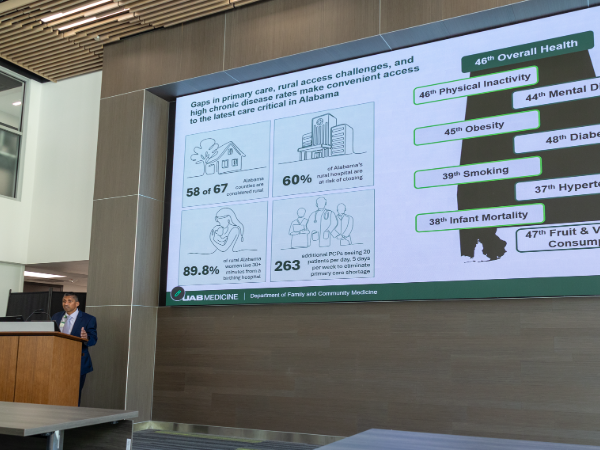
 Irfan Asif, M.D., addresses Alabama's health challenges during the Family and Community Medicine State of the Department.The UAB Department of Family and Community Medicine Chair Irfan Asif, M.D. outlined a year of program growth and strategic investments, this week, as well as spotlighted faculty and staff achievements during his State of the Department address.
“Our vision is to build an integrated, technology-enabled network that expands access, advances innovation, and develops the workforce needed to serve every Alabamian,” explained Asif. “Putting together this State of the Department really emphasized what an incredible year we have had and the impactful work being done by everyone within Family and Community Medicine.”
Throughout the presentation, Asif highlighted alignment between the department’s mission statement and its culture and service. He focused on the department’s growing clinical footprint, its primary care workforce development and innovative research.
Asif emphasized the department’s mission to improve health outcomes in a state that consistently ranks among the lowest, nationally.
“If we look at the health outcomes in the state, Alabama typically ranks anywhere from 46 to 49 in our overall health outcomes, and those rankings mirror the chronic diseases that we see,” said Asif. “I think that we're in a time right now where if we can align some of the efforts that we see within our department with some of the national priorities, we may be well-poised to address some of these health outcomes.”
Expanding access to primary care
“We've spent a lot of time on the word ‘access,’” Asif shared. “How can we get patients in? How can we get patients in… particularly those that have chronic disease needs? That was very important to us.”
To increase access to vital primary care, the department opened a new clinic, expanded services and added capacity for walk-in and same day appointments. The new UAB Family Medicine East Clinic at UAB St. Vincent’s East extended the department’s reach into eastern Birmingham. The Family Medicine Clinic at UAB Hospital-Highlands began offering same-day, urgent care appointments with our resident physicians and APPs. This walk-in clinic treated everything from cold and flu symptoms, sprains, cuts and burns to allergic reactions, urinary symptoms, and women's health concerns. Now residents are offering urgent care services one day each week at Hoover Family Medicine. Additionally, the employee primary care clinic at TKC expanded services to include employee’s adult family members.
Building the primary care workforce
Family and Community Medicine is working to develop and sustain an interprofessional workforce that recruits Alabama students, trains them in high-need communities, and supports them to stay and serve. These efforts include building a robust pathway that promotes health care careers beginning as early as middle school and continues through postbaccalaureate, medical school, residency, and fellowship programs. The department also provided more than $1.7 million in scholarships and stipends for students interested in pursuing family medicine careers.
“We've really been able to create these integrated programs across the spectrum, and then to offer that scholarship and support so that people can graduate,” said Asif. “We need to continue to find ways to support our students, particularly the debt burden. I appreciate that we have opportunities to help relieve some of the debt that students have as part of their training.”
Driving innovation and chronic disease prevention
 A recording of this week's Family and Community Medicine State of the Department is available for review. Now ranked No. 13 in family medicine research nationally, the department’s research faculty and leadership are focused on health promotion, quality improvement, chronic disease prevention, and rural health policy. As part of these efforts, the presentation highlighted the country’s first telehealth outreach and policy rapid response center (TOP-UP) and the HEART-NET Primary Care Research Network.
“What we see within Alabama is not unique,” explained Asif. “In the Deep South, you see that there are the same sort of chronic conditions and the same sort of poor health outcomes.”
HEART-NET addresses barriers to access to clinical research participation by integrating innovative research with routine clinical care in real-world settings.
Asif ended the presentation by expressing his appreciation for his colleagues and looking towards the future.
“This presentation was a wonderful opportunity to recognize the team and celebrate the impact we’re having on primary care across Alabama through education, research, clinical care, and the culture of service embraced by everyone in the department… Again, this was really fun to put together, and I want to thank you for all the work you do.”
If you are interested in learning more or you would like to review the slides, the department has made links available to the recording as well as to the presentation deck.