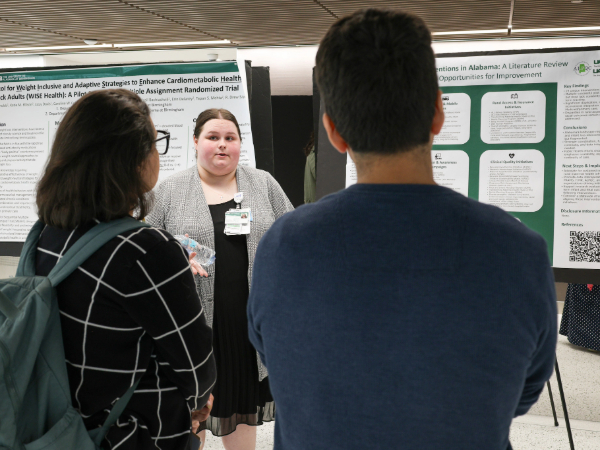
 Words have power. That is why MS4 Anna Ulrey, a student in the Department of Family and Community Medicine's Comprehensive Urban Underserved and Rural Experience (CU2RE) program, has used her research project, “Safe Words in Lifestyle Medicine,” to explore how language can transform patient care and meaningful primary care research can shape clinical practice.
“Working on this project has shown me how powerful research in primary care can be,” said Ulrey. “Primary care is where conversations about health actually happen and being able to study how our words shape patient trust and engagement has been incredibly meaningful.”
Can you share more about “Safe Words in Lifestyle Medicine”?
Ulrey: “Safe Words in Lifestyle Medicine” is a research project exploring how patients perceive weight-related language in clinical settings. We’re studying which terms feel motivating, neutral, stigmatizing, or harmful when discussing weight in primary care. Lifestyle counseling is central to primary care. But if the language we use unintentionally alienates patients, we undermine the behavior change we’re trying to support. Our study uses survey data to better understand patient preferences so clinicians can communicate in ways that are both evidence-based and psychologically safe.
Why this project? What attracted you to this research?
Ulrey: I’ve witnessed and personally experienced how conversations about weight can either open a door or shut it completely. That tension fascinated me. If primary care is rooted in longitudinal relationships, then communication is one of our most powerful tools. I was excited by the idea that something as simple as refining our language could meaningfully improve patient trust and adherence.
What has surprised you most about Family and Community Medicine research?
Ulrey: I’ve been most surprised by how immediately applicable it is. Family and Community Medicine research often answers practical, real-world questions, not abstract ones. The work isn’t about prestige; it’s about improving care where people actually live.
So far, what have you taken away from this experience? How will it affect your future research endeavors?
Ulrey: This experience has reinforced that research doesn’t have to be large-scale or flashy to be meaningful. It can start with a simple question: “Is there a better way to do this?” It’s also strengthened my appreciation for patient-centered outcomes. Moving forward, I want my research, regardless of specialty, to stay grounded in lived patient experience.
How have mentors influenced, guided and/or enriched your research experience?
Ulrey: My mentors have been foundational. They created space for ownership while offering guidance at key transition points. They modeled curiosity, rigor, and humility. They pushed me to clarify my question, refine methodology, and think critically about interpretation, but they also reminded me that research is ultimately about people.
Do you have any additional upcoming conferences or publications planned? Would you like to continue presenting or publishing on this study?
Ulrey: We are actively working toward presenting the findings at upcoming conferences and pursuing publication. I would absolutely like to continue presenting and publishing on this study, particularly as we refine the data and explore next steps.
Do you foresee integrating primary care research into your career moving forward? If so, how?
Ulrey: Regardless of where my career ultimately lands, I see research as part of how I practice medicine. Primary care research, in particular, has shown me the value of studying communication, prevention, and community-level interventions. Even if my future work evolves, I want to maintain that lens: research that strengthens patient relationships and improves everyday care.
Were you previously interested in family medicine research?
Ulrey: Before medical school, I didn’t fully appreciate what family medicine research looked like. I associated research more with bench science or subspecialty trials. Through this experience, I’ve realized how impactful primary care research can be. It directly shapes how physicians talk, counsel, and build trust, which ultimately affects health outcomes just as much as medications do.
How has CU2RE played a role in your journey towards becoming future physician?
Ulrey: CU2RE has provided structure, mentorship, and accountability. It offered a framework to turn curiosity into scholarship. More importantly, it reinforced the idea that research is accessible, not something reserved for a select few.
The CU2RE Program is supported by the Health Resources and Services Administration (HRSA) of the U.S. Department of Health and Human Services (HHS) as part of an award totaling $17.175 million with 10% financed with nongovernmental sources. The contents are those of the author(s) and do not necessarily represent the official views of, nor an endorsement, by HRSA, HHS, or the U.S. Government.